


2022: BEUC – 60 years young, 60 years strong


On 6 March 2022, the Bureau Européen des Unions de Consommateurs turned 60. We used the opportunity to take stock of what has happened in recent decades. This has proved to be an acrobatic exercise: how to squeeze many years of amazing developments into a brochure? We managed to do so and you can read how for instance we helped to remove lead from petrol in the 1980s. Our top takeaway from 60 years of advocacy? Achieving progress in consumer protection is a marathon, not a sprint.
Most of our time in 2022 was of course spent on protecting consumers in the present. For example, we managed to considerably improve two new pieces of EU legislation – the Digital Markets Act and Digital Services Act – which will boost online consumer choice and protection. We also successfully achieved better rules to protect consumers when they take out small loans or use ‘Buy Now Pay Later’ schemes.
BEUC also successfully intervened before the EU Court, which sided with consumers when it ruled that Google broke EU antitrust laws by imposing illegal restrictions on Android device manufacturers and mobile networks. Thanks to this ruling consumers will benefit from a more open and innovative digital environment.
We are not short on challenges. The ‘perfect storm’ of spiralling living costs dominated newspaper headlines in 2022. Rising energy prices, partly linked to the Russian invasion of Ukraine, led to rampant inflation. This created many worries for Europeans about the future. To weather this storm, we developed solutions for policymakers. We particularly underlined that this crisis should propel us towards – not away from – sustainable lifestyles.
Results from pan-European projects run by our members helped to gather evidence from the ground. Our project to combat energy poverty led to recommendations for both consumers (choose LED lightbulbs) and policymakers (simplify energy bills) alike. We also coordinated the launch of collective purchase campaigns for tumble dryers and solar panels aiming to help households across Europe to improve their energy efficiency. Are you renting? Buying a piece of a solar park might be an advantageous option.
Beyond these projects, a major barrier for consumers to adopt more sustainable lifestyles must be tackled: high upfront costs. To fill the investment gap, we argued that financial instruments – such as green loans – must be made available and tailored to consumer needs.
The cost-of-living crisis is not the only area where consumers faced headwinds. For example, we called out the EU’s institutional greenwashing of sustainable finance after it included fossil gas and nuclear energy in its so-called ‘taxonomy’ on what investment is or isn’t green. We also criticised policymakers’ lack of action on tackling the sale of dangerous products via online marketplaces.
Dangerous products are just one of many challenges in the digital age. We are also witnessing the sudden omnipresence of commercial surveillance and targeted advertising. This puts consumers in a position of less power: ‘digital asymmetry’. We hosted a conference with high-level EU and US policymakers, offering ways to address this asymmetry in consumer and digital regulation, as well as its enforcement.
By the time of writing this introductory note, BEUC has turned 61. The marathon of improving the everyday lives of European consumers continues into its next leg.

Making EU decisions work for consumers
Our work led to new laws, rules and decisions that will improve people’s lives:
We recognised this EU legislation to be a milestone for consumers and businesses who have suffered from Big Tech’s harmful practices. The Digital Markets Act sets obligations and prohibitions for Big Tech companies to ensure they do not harm consumers by stifling innovative competitors or using unfair business practices. Such prohibitions include promoting their own services over the services of competitors or requiring the use of their own digital payment services for app purchases. The rules will therefore give consumers greater choice and protection, for example over which apps and services they use.
While this landmark law starts to apply in stages from May 2023, actual changes in the market are not expected until March 2024, when the Commission will designate which companies constitute internet “gatekeepers”. Once this happens, these companies will have six months to comply with the Digital Markets Act’s obligations.
We concluded the Digital Services Act helps to achieve a fairer digital society. The legislation inter alia requires online marketplaces to verify that the sellers who use their platforms are legitimate. As research by the BEUC network has repeatedly shown, online marketplaces are awash with unsafe and illegal goods and this happens because these marketplaces do little to nothing to check who the sellers are. The Digital Services Act also further restricts the use of sensitive or children’s data for targeted advertising. In BEUC's view, the success of the law – which applies as of February 14, 2023 – depends on its effective enforcement.
In December, the European Parliament and the EU Council of Ministers reached a political agreement on a revised Consumer Credit Directive – which reflects BEUC’s recommendations. For instance, consumers taking out small loans below €200, leasing agreements or ‘Buy Now Pay Later’ schemes will in the future protected by new rules. This includes a strong creditworthiness assessment, which prevents pushing vulnerable consumers into over-indebtedness.
At the time of writing, policymakers have not yet definitively adopted the revised Directive which means it is not yet known when the new rules will apply.
The General Court largely upheld the European Commission’s 2018 decision that Google broke EU antitrust rules by imposing illegal restrictions on Android device manufacturers and mobile network operators to cement its dominant position in general internet search. We recognised that this ruling was crucial because it confirmed that Europe’s consumers must enjoy meaningful choice between search engines and browsers on their phones and tablets.
BEUC intervened at the Court in support of the European Commission and the ruling explicitly recognised the legitimacy of BEUC’s position as a representative of consumers’ interests. We highlighted the way in which Google exploited consumers’ behaviour in real life, for example by keeping pre-installed search and browser apps rather than changing to alternatives, to deprive them of genuine choices.
We welcomed the European Commission’s antitrust decision to accept commitments from Amazon to allow more competition on its online marketplace. BEUC had requested a series of improvements to Amazon’s proposals for commitments, which were addressed in the final version of the decision.
The antitrust decision followed a Commission investigation into Amazon over concerns that it could be breaking EU antitrust rules’ ban on abuse of a dominant market position. The Commission’s concern was that Amazon was giving preference to its own products and services (so-called “self-preferencing”) such that other sellers could be unable to use Amazon’s online marketplace as effectively as Amazon could.
A reform of EU product safety law was agreed in November. The reform was necessary as existing legislation no longer reflected today’s digital and globalised market. We considered the new law, called the General Product Safety Regulation, ticks many consumer protection boxes. For instance, the assessment of what is a ‘safe’ product will have to consider cybersecurity, and consumers will be entitled to receive remedies in case of a product recall. In contrast, we criticised the new law for not fully tackling the sale of dangerous or non-compliant products via online marketplaces. Once the law is finally adopted in 2023, it will apply 18 months later.
In April, EU Member States agreed to extend roaming rules to 2032 and introduce improvements called for by BEUC to further benefit consumers. In addition to a continued ban on roaming charges, telecom operators now have to provide consumers with the same quality of service when roaming as when they are in their home country, if technically feasible. Consumers will also be better protected against bill shocks caused by connecting inadvertently to a non-EU mobile or a satellite network. The new rules entered into force on July 1, 2022.

Setting the agenda to improve the lives of consumers
We brought consumer concerns, issues, expectations and opportunities into the public eye:
To help drivers cut CO2 emissions, it is important they can make the most sustainable choice. Following up on an earlier study where we found that electric cars will benefit consumers’ wallets, we assessed these vehicles’ environmental credentials and their link to price and emissions. Firstly, we found that batteries are expected to last at least as long as the car itself, making out-of-warranty replacement unlikely. Secondly, we found that electric cars emit less CO2 than petrol cars even when considering their production. And, finally, even if electric cars were produced more sustainably, they would still be cheaper than conventional cars.
Illegal teeth-whitening products, dangerous toys, and an air fryer that emitted smoke: a compilation of research by BEUC members glaringly showed that online marketplaces fail to prevent dangerous products from appearing on their sites. Later in the year, we criticised EU policymakers for pushing the issue of dangerous products sold online like a hot potato between reforms of e-commerce, product safety, and product liability laws without any serious effort to tackle it. BEUC will continue to advocate making online marketplaces liable for dangerous products sold online by third-party vendors using their platforms.
Looking at an uncertain winter, we said the European Commission made the right call in creating a temporary cap on revenues from renewable, coal and nuclear power producers, and requiring fossil fuel companies to pay a solidarity contribution. We urged policymakers to channel these revenues to providing financial support to help consumers keep up with their payments and reduce their energy consumption. We also called for clearer information from energy suppliers about tariffs.
Unprecedented increases in energy bills during 2022 placed a major strain on household budgets. Responding to the EU’s ‘REPowerEU’ strategy to move away from Russian fossil fuels, we highlighted ten ways how national governments can help consumers through the crisis. As a short-term measure, we urged public authorities to organise collective purchase campaigns to bulk buy energy-efficient products (such as LED light bulbs). In the long term we suggested measures to help consumers save energy, such as cutting the red tape involved in installing rooftop solar panels and home renovations.
To provide urgent relief, we signed a declaration in December with the energy industry and regulators on emergency measures such as bill deferrals, alternative payment plans and avoiding disconnections or unilateral price increases.
A test by the BEUC network showed how silicone baking moulds can contaminate cakes, cookies and other baked goods with unwanted chemicals. While none of the tested products in isolation may endanger human health, the results illustrated that there is ample room for manufacturers to improve. EU legislation meant to protect consumers is half baked as it essentially only regulates plastic materials. We urged the EU to rethink its food packaging laws to better protect consumers.
Dynamic electricity price contracts are increasingly available to consumers. With these contracts, the electricity tariff changes every hour and is linked to prices in wholesale electricity markets. To assess the impact of dynamic price contracts – and how best to inform consumers about whether they could be suited to them – we commissioned a report.
We found these contracts can help consumers make savings, but only when the average variable electricity price is lower than that of fixed price contracts. The main benefit could be for those with an electric car, which is the highest single cost within flexible electricity consuming households’ activities. In contrast, the benefits from using white goods (such as a dish washer or washing machine) flexibly are relatively minor due to their small share in the total bill.
Fighting the climate crisis requires profound changes to the way we live. This includes renovating our homes and switching to renewable heating solutions, more efficient household appliances and electric cars. However, high upfront costs to install insulation or a heat pump often prevent consumers from taking the leap. To overcome this investment gap, we explained that new financial instruments – such as green loans – must be made available and tailored to consumer needs.
Surveys by five BEUC members revealed that people have real difficulties in getting the medicines they need because of shortages. The survey highlighted that almost one in three people who had experienced a medicine shortage suffered health complications as a result. BEUC recommended that Member State authorities require pharmaceutical companies to submit drug shortage prevention plans, to identify risks and promote mitigation measures. We also called for stronger sanctions for companies that do not ensure appropriate and continued supplies of products as required by law.
High medicine prices put pressure on national health budgets, requiring governments to make ever more difficult decisions about which medicines should be reimbursed by the state. As the EU rolls out its pharmaceutical strategy, and prepares to review pharma legislation, we thought it important that policymakers be aware of consumers’ attitudes to medicine pricing. We commissioned focus groups to get more data and found that people consider medicines an essential good. As a result, high drug prices and excessive profits by pharma companies do not sit well with consumers, and even less so when they consider the role of the public sector in medicine development.
Commercial surveillance is already everywhere. Everything we do – where we go, what we like and what we buy – is being monitored by companies and used to influence our choices and decisions. But it could get much worse. To show how invasive commercial surveillance practices are and could become, we made a video on the surveillance economy which combines situations from today with scenarios in the not-too-distant future. We believe the EU must act to #StopCommercialSurveillance.
Loot boxes are ‘mystery packages’ of digital content in video games which consumers purchase with real money. They give gamers advantages or items to use in the game. However, a report by BEUC’s Norwegian member Forbrukerrådet showed that manipulative design, aggressive marketing and misleading probabilities are just some of the problematic practices consumers face with loot boxes.
20 BEUC members subsequently jointly called for more protection of European consumers and further regulation on loot boxes.
We teamed up with Consumers International to organise an information session for country delegations at the World Trade Organization in Geneva as they negotiate a global trade deal on e-commerce. Our message to negotiators: any international agreement that covers data flows must protect people’s fundamental rights and preserve countries’ ability to regulate in the public interest. This point was underlined by speakers from Chile, Kenya, South Korea, the United States, and BEUC’s Norwegian member Forbrukerrådet.

Speaking up for consumers in debates on (future) policy
The voice of consumers must be heard throughout the EU decision-making process. We made the following comments about ongoing policy developments:
The EU’s development of a list of economic activities that can be classified as a ‘green’ investment – the so-called taxonomy – ended up in a shambles after it was decided to include nuclear energy and fossil gas. We had advocated against this unacceptable institutional greenwashing. That is because it misleads consumers about how sustainable their investments are and increases their exposure to stranded assets.
BEUC and other NGOs also walked out of the European Commission expert group as we deemed it acted against evidence despite a legal obligation to follow science-based advice. To help consumers who want to invest sustainably in the coming years, we suggested the creation of a science-based alternative taxonomy.
As part of its ‘circular economy package’, the European Commission proposed new EU rights to protect consumers from unfair commercial practices such as premature obsolescence and greenwashing. We commented that EU rules are desperately needed to guide consumers through a market of green claims such as ‘CO2 neutral’. In our recommendations to improve the proposals, we called for national or EU authorities to pre-approve any green claim.
Products are often not built to last, wear out too quickly, and are difficult to repair – straining consumers’ wallets and harming the environment. The European Commission’s ‘circular economy package’ also included proposals for new sustainability requirements for manufacturers, as well as obligations for companies to present information about the durability and repairability by way of a review of current EU Ecodesign legislation.
We commented that Ecodesign must be used to make sustainable products the norm. Together with our sister organisation ANEC (the consumer voice in standardisation), we analysed the EU’s ideas and highlighted that information requirements should always complement, but never substitute, design requirements. Building on lessons learned from the PROMPT project on premature obsolescence, we also urged the EU to introduce a scoring system that helps people compare the repairability of products at purchase: the ‘repair score’.
Too many products lack even basic cybersecurity features, leaving consumers exposed to cyberattacks. The BEUC network has repeatedly warned about this risk. In our view, the market has failed to deliver on cybersecurity. So when the European Commission proposed mandatory security requirements for products as diverse as connected toys, PCs or smartphones, we said this could substantially improve the worrying situation today.
However, we urged the EU to classify certain consumer products – such as children's devices or internet routers – as high risk and require them to be certified by third parties. Manufacturers must also tackle cybersecurity vulnerabilities during a product’s expected lifespan. Finally, we said consumers should have more effective redress mechanisms for when things go wrong.
We expressed our disappointment at the position of the EU Council of Ministers on the AI Act. Member States left many important issues unaddressed, such as facial recognition by private companies in publicly accessible places. They also ignored calls to grant consumers basic rights when they are subject to automated decisions or interact with an AI system. To avoid that this legislation fails to properly address the challenges of AI, we urged the European Parliament to stand up for consumers.
The European Commission has proposed to update civil liability rules for products and services in the digital era. BEUC has repeatedly called for the modernisation of these rules, and for a clear and enforceable legal framework. The proposed new rules contain positive changes, such as including ‘data loss’ as a type of damage manufacturers can be liable for. Software can also be considered a product and therefore covered by EU product liability rules.
However, we criticised the fact that consumers would be less well protected when it comes to AI services, because they would have to prove the operator was at fault or negligent in order to claim compensation for damages. As a result, consumers would be better protected if a lawnmower shreds their shoes in the garden than if they are unfairly discriminated against through a credit scoring system.
We criticised a US Executive Order published in October, which lays the ground for a new EU-US data transfer agreement, because it brings no substantial improvements to address issues related to the commercial use of personal data. This is an area where the previous agreement, the EU-US Privacy Shield, fell short of EU data protection (GDPR) requirements. The US still has no federal data protection law providing equivalent protection to the GDPR. We concluded that a satisfactory data flows agreement requires legislative reform in the US.
The EU decided in October to reduce CO2 emissions from cars by 100% in 2035 (with the year 2021 as baseline). We recognised this decision as good news for consumers as it stimulates car makers to rapidly bring cleaner vehicles such as electric cars to market. As BEUC research has shown, electric cars benefit the environment and people’s wallets. Particularly second- and third-hand owners stand to make savings as they bear less of the car’s depreciation and benefit from low maintenance and running costs. This EU decision will effectively help to create this second-hand market, which will in turn bring forward the expected savings for consumers.
BEUC participates in the European Financial Reporting Advisory Group, which in November submitted to the European Commission the first draft standards for mandatory sustainability reporting by big companies in the EU. We recognised that these standards will make it easier for consumers to see who is or isn’t sustainable, allowing them to make more sustainable purchases and investments. The European Commission is expected to submit the draft standards to public consultation in spring 2023.
In a letter to EU Commissioners, BEUC, the European Heart Network and the European Public Health Alliance urged the European Commission to come forward with a proposal on front-of-pack nutrition labelling as soon as possible. We advised the European Commission not to lose sight of the central purpose of this policy tool: to help consumers make healthier choices in time-pressured environments such as busy supermarkets. This was set in a context where the debate on nutrition labelling had become increasingly polarised and less grounded in scientific evidence.
Health data is highly sensitive. It can not only have a big impact on a person’s health but also, for example, on job applications or on getting approval for a bank loan. Because of this sensitivity, health data is subject to a high standard of protection under the General Data Protection Regulation.
In this context, we labelled a proposal to create a ‘European Health Data Space’ as deeply flawed. The proposed Data Space aims to help individuals make their health information easily accessible and supports the secondary use of health data to improve public health care. BEUC however underlined that the proposal leaves many important questions unanswered and puts the protection of personal data and privacy at risk. For instance, consumers must be able to actively give consent (opt-in, not opt-out) to the primary use of their health data.
The current EU food system is unsustainable. It both suffers from and drives climate change, pollution and waste, loss of biodiversity, and diet-related non-communicable diseases – among others. Sustainable healthy diets are a win-win for health, climate and food security. A 2020 BEUC survey showed consumers are open to changing their food habits in favour of sustainability yet face barriers – including price, lack of knowledge, the challenge of identifying sustainable food options and their limited availability.
In its Farm to Fork strategy, the European Commission announced it would legislate for a sustainable food system. We called for a paradigm shift so that foods which contribute to sustainable healthy diets are the most available, accessible, affordable, attractive and widely promoted. Concretely, we urged adoption of a high-level umbrella law which sets the direction of travel and establishes key definitions (e.g. ‘healthy diet’), principles (such as ‘Polluter Pays’, ‘One Health’), and objectives, as well as time-bound targets.
After the EU and New Zealand concluded trade negotiations, we analysed the results. BEUC welcomed positive elements for consumer protection such as easier access to redress and cooperation on the safety of products sold online. We also noted there is clearer protection for personal data and safeguards for regulatory oversight of artificial intelligence. These elements should be further improved and become a model for future deals.
However, the agreement is not a model for sustainable trade. BEUC does not see how importing more sheep meat and dairy products from New Zealand can contribute to tackling climate change. Especially when consumers are advised to reduce their consumption of meat and dairy for health and environmental reasons. There is a clear clash here between EU trade policy and its Green Deal. Future trade deals will need to prove that that these policies can be better aligned.

Beyond advocacy: enforcement
The BEUC network acted to make sure companies abide by EU rules.
When the European Commission and national consumer authorities closed their investigation into TikTok, we said it left consumers in the dark. The investigation had followed a process that began in February 2021, when the BEUC network alerted the authorities to multiple infringements putting TikTok users at risk. Despite some improvements to TikTok’s policies, we said some worrying issues – such as the absence of a mechanism to protect young consumers from abuse by influencers when they purchase TikTok ‘virtual coins’ – remain open or unresolved. We urged authorities to closely monitor TikTok’s activities and to take national enforcement action if commitments do not deliver.
18 BEUC members were involved in this action: Testachats/Testaankoop (Belgium), Κυπριακού Συνδέσμου Καταναλωτών/Kypriakos Syndesmos Katanaloton (Cyprus), dTest (Czechia), Forbrugerrådet Tænk (Denmark), UFC-Que Choisir (France), Verbraucherzentrale Bundesverband – vzbv (Germany), Ε.Κ.ΠΟΙ.ΖΩ/EKPIZO (Greece), Altroconsumo (Italy), Consumatori Italiani per l'Europa – CIE (Italy), Consumentenbond (the Netherlands), Forbrukerrådet (Norway), Spoločnosť ochrany spotrebiteľov Poprad – S.O.S (Slovakia), Zveza Potrošnikov Slovenije – ZPS (Slovenia), Sveriges Konsumenter (Sweden), OCU (Spain), Asufin (Spain), and Fédération Romande des consommateurs (Switzerland).
Tech giant Google unfairly steers consumers towards its surveillance system when they sign up to a Google account, instead of giving them privacy by design and by default as required by the General Data Protection Regulation (GDPR). As a result, we took action to ensure that Google complies with the law, including by filing complaints with national data protection authorities. We highlighted how Google uses a combination of deceptive design, unclear language, misleading choices and missing information.
Ten BEUC members participated in the action: dTest (Czech Republic), UFC-Que Choisir (France) Ε.Κ.ΠΟΙ.ΖΩ/EKPIZO and ΚΕ.Π.ΚΑ/KEPKA (Greece), Forbrukerrådet (Norway), and Zveza Potrošnikov Slovenije – ZPS (Slovenia) filed complaints with their data protection authorities. Verbraucherzentrale Bundesverband – vzbv (Germany) sent a warning letter to Google. Forbrugerrådet Tænk (Denmark), Consumentenbond (the Netherlands), and Sveriges Konsumenter (Sweden) wrote to their national authorities to alert them about Google’s practices. Our partners in the Transatlantic Consumer Dialogue also sent a letter to the US Federal Trade Commission denouncing Google’s practices.
In 2022, the EU was making up its mind over which front-of-pack nutrition label should end up on food products. In this context, BEUC filed a complaint over a concern that a consultancy and the No-Nutriscore Alliance provided misleading and partial information about the reality of their relationships, the interests they represent and the sources of their funding. Several reasons led us to believe that the alliance is nothing less than a window dressing entity. We welcomed debate about the pros and cons of Nutri-Score, a label BEUC staunchly supports, provided it is based on science and interests are openly declared.

Running projects to advance the consumer interest
For three years, BEUC’s Solutions to Tackling Energy Poverty (STEP) helped over 16,000 people across Europe to find simple and cost-effective solutions to cut their energy consumption. The project drew to a close in May with an event where frontline workers shared their experiences. All in all, STEP triggered 38.4 GWh in primary energy savings. BEUC also revealed 10 practical tips how to save money on energy bills. STEP one: uncover your radiators. Finally, we distilled best practices and recommendations for policymakers, where we underline the need for user-friendly energy bills.
Funded by the EU’s Horizon 2020 programme, STEP united consumer organisations with frontline worker associations. BEUC members involved in the project included Асоциация Активни потребители/Asotsiatsiya Aktivni Potrebiteli (Bulgaria), Κυπριακού Συνδέσμου Καταναλωτών/Kypriakos Syndesmos Katanaloton (Cyprus), dTest (Czech Republic), Latvijas Patērētāju interešu aizstāvības asociācija – LPIAA (Latvia), Vartotojų aljansas (Lithuania), Federacja Konsumentów (Poland), DECO (Portugal), Spoločnosť ochrany spotrebiteľov Poprad – S.O.S (Slovakia), and Citizens Advice (United Kingdom).
The EU Ecolabel turned 30 in 2022. As of September, there were over 87,000 goods and services on the EU market carrying this voluntary label which promotes products of environmental excellence. We teamed up with the European Environmental Bureau and EuroCommerce (the voice of the retail and wholesale sector) to underline in visual and written format how the EU Ecolabel benefits consumers and retailers. For instance, retailers can ensure consumers’ trust by using the EU Ecolabel and at the same time be ahead of future EU advertising rules.
Commercial surveillance, automated decision making, black box algorithms, personalised persuasion and targeted offers are now omnipresent. Consumers are put in a position of ‘digital asymmetry’ – a state of power imbalance which requires a fundamental rethinking of existing legal protection and the very notions of fairness in the digitalised world. In September, BEUC invited people to Brussels to discuss how we can do so. Speakers included Margrethe Vestager (European Commission), Shoshana Zuboff (author of The Age of Surveillance Capitalism) and Samuel Levine (US Federal Trade Commission).
This activity was part of a multi-year project looking at the challenges posed by the digitisation of markets. We concluded consumer law is currently not fit for purpose to address these challenges and provided advice on how to change it. For instance, we urged a reform of the Unfair Commercial Practices Directive so as to include the concepts of digital vulnerability and asymmetry. This project was supported by the Adessium Foundation.
In the context of ConsumerPRO, an initiative supported via the European Consumer Programme, we continued to build the capacity of the consumer movement. Hundreds of staff and volunteers from national authorities, European Consumer Centres and consumer organisations were trained on how to best support consumers in the areas of general consumer law, digital rights and collective redress. We also organised workshops to exchange best practices and to encourage networking on cross-cutting topics and soft skills like consumer education. These online sessions touched upon how to deliver effective consumer education activities for adults and younger audiences, and they fostered ideas about future projects and partnerships with authorities at local, national or pan-European level.
As it is equally important to train businesses, we also contributed to training courses through Consumer Law Ready, an EU-funded project to support SMEs comply with contract and marketing law.
Our network acted to help consumers get access to renewable energy at an affordable price. Inspired by price comparison tools, BEUC members helped consumers understand how much they could save through using energy-efficient and renewable energy technologies. Members also launched collective purchase campaigns to help consumers overcome the investment barrier. The campaigns included heat pump-based tumble dryers in Slovenia and solar panels in Slovakia. Going beyond conventional purchases, a campaign in Lithuania will give consumers the opportunity to buy a ‘piece’ of a solar park which could be specifically helpful for people living in flats or who are tenants.
These actions are part of EU Horizon 2020-funded project CLEAR-X (‘Consumers Leading the EU’s Energy Ambition Response, Expansion’). This is led by our sister organisation International Consumer Research & Testing (ICRT) and seven national consumer organisations: Асоциация Активни потребители/Asotsiatsiya Aktivni Potrebiteli (Bulgaria), Κυπριακού Συνδέσμου Καταναλωτών/Kypriakos Syndesmos Katanaloton (Cyprus), Vartotojų aljansas (Lithuania), Организација на потрошувачите на Македонија/Organizacija na potrosuvacite na Makedonija – OPM (North Macedonia), DECO Proteste (Portugal), Spoločnosť ochrany spotrebiteľov Poprad – S.O.S (Slovakia), Zveza Potrošnikov Slovenije – ZPS (Slovenia).
A 2020 law requires all EU countries to put in place collective redress procedures (officially called ‘representative actions for redress’). Between October 2021 and September 2023, BEUC is running a project to help consumer organisations and digital rights groups contribute to the national implementation of this law and to prepare the best way to fund and run collective redress. The project is funded by Luminate.
In 2022, we concluded that the creation of a public fund, which is explicitly mentioned in the law, is the most appropriate way to ensure proper financing of collective actions in the EU. To ensure consumers receive redress, we also looked at the practicalities of running cases and advocate an opt-out rather than an opt-in system. In addition, we also started training courses on collective redress and organised a round table on private international law in cross-border collective redress cases.

2022 at BEUC in numbers
We issued 53 press releases and were contacted by journalists 261 times, which led to over 7,500 quotes in the written press.
In addition, we gave 48 in-depth interviews to media outlets.
BEUC staff spoke at a total of 203 public events across all our topics.
We had various meetings with the European Commission: 4 with Commissioners, 12 with Directors-General or Deputy Directors-General, and 163 with staff from a variety of departments that work on consumer-related topics.
We organised events on topics such as helping to save money on energy bills, how big tech companies can stifle innovation, and whether EU plans for air pollutant emissions from cars headed in the wrong direction (yes, we said).
On our blog – the Consumer Corner – staff from the BEUC Secretariat in Brussels or national consumer organisations gave their views in 17 posts. These included topics such as what it is like to own an electric car, how to convince one’s landlord to put solar panels on the roof, the downsides of moving to digital-only leaflets for medicines, the EU’s new environmental calculating method, our relentless quest for collective redress that works for consumers, a series about our 60th anniversary, and more.

Fundraising & Finance
For 60 years, BEUC has worked relentlessly to represent the interests of European consumers. By working closely with our members, we bring together consumers’ viewpoints from across Europe, and apply these to our work in the EU policy-making arena. As a not-for-profit organisation, our policy successes would not be possible without the funding support we receive from both our members and our supporters. We are immensely grateful for this support, which allows us to achieve greater impact and to represent the consumer voice on a broad range of priority issues.
It is our policy to seek funding only in priority areas identified by our members as important for consumers. This funding can be either unrestricted (to support our core work) or tied to a specific project or programme. All potential funders are carefully vetted through our due diligence process to ensure that they align with our goals and do not threaten our integrity and independence.
Our work in 2022 was supported by the following grants and contracts:
EU operating grant
This grant is received from the consumer strand of the Single Market Programme 2021-27.
EU funded projects
Consumer Law Ready, 2019-2023
Participation in the EU Ecolabel Scheme (with European Environmental Bureau), 2019-2023
Participation in the Ecodesign requirements (with ANEC), 2020-2023
PROMPT (Premature Obsolescence Multi-Stakeholder Product Testing Programme), Horizon 2020, 2019-2023
STEP (Solutions to Tackle Energy Poverty), Horizon 2020, 2019-2022
BELT (Boosting Energy Label Take-up), Horizon 2020, 2019-2022
Consumer Pro: Strengthening Consumer Representation in Europe, 2021-2023
CLEAR-X (Consumers Leading the EU’s Energy Ambition Response), 2021-2024
Consumer Pro: Strengthening Consumer Representation in Europe, 2019-2023
Foundations that support our work (A-Z)
Children’s Investment Fund Foundation via European Climate Foundation
Climate Finance Fund (CFF)
European Environmental Health Initiative (EEHI) via Swiss Philanthropy Foundation
Healthy Food, Healthy Planet via a collaboration with the Eurogroup for Animals
Kristian Gerhard Jebsen Foundation via a collaboration with Zero Waste Europe
Our income
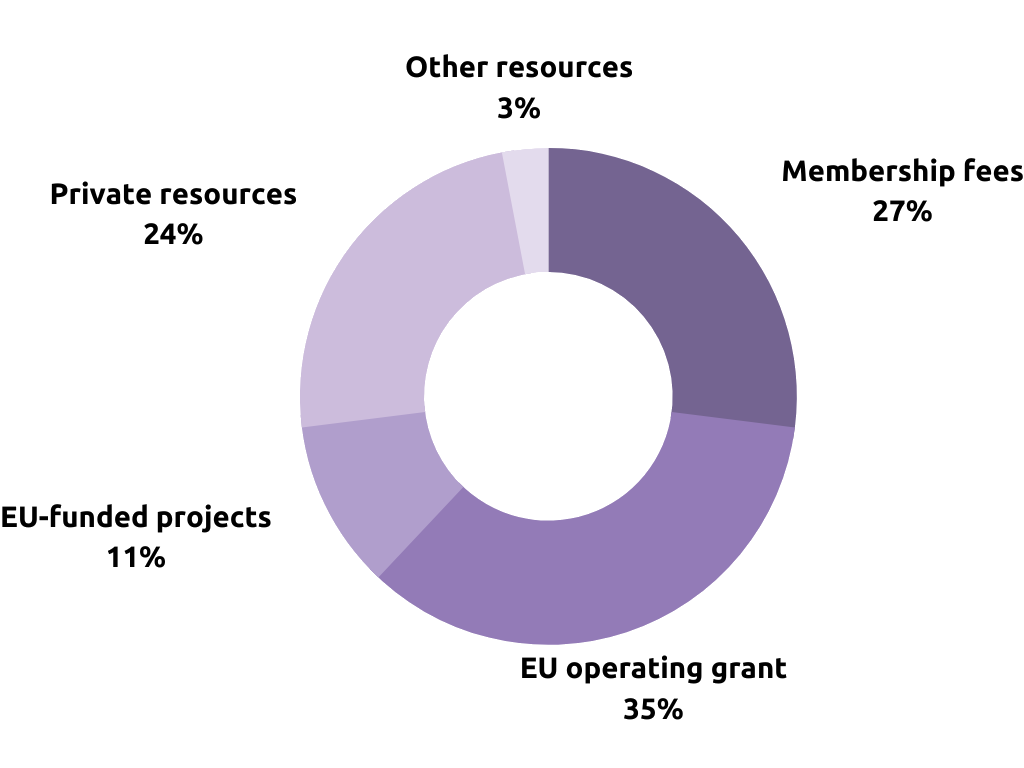
Our income in 2022 was €5,966,647. This includes:
-
35% - An EU operating grant from the consumer strand of the Single Market Programme 2021-27 to support our work on behalf of European consumers
-
27% - Membership fees from our members (independent consumer organisations)
-
24% - Foundation-funded projects
-
11% - EU institution-funded projects which we deliver following successful bid submissions to competitive open and limited calls for proposals
-
3% - Other income
Statement of operations
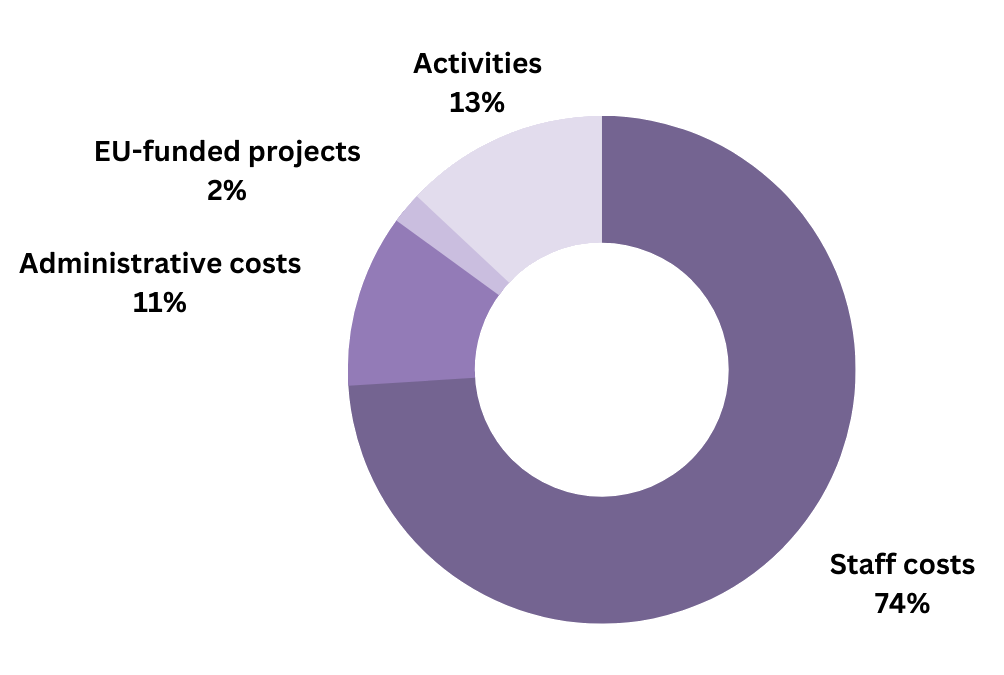
| Resources 2022 | (in euros) | Expenditure 2022 | (in euros) |
| Membership fees | 1,629,770 | Staff costs | 4,637,660 |
| EU operating grant | 2,061,845 | Administrative costs | 703,522 |
| EU-funded projects | 682,320 | Activities | 803,174 |
| Private resources | 1,432,497 | EU-funded projects activities | 149,318 |
| Other resources | 160,215 | ||
| Total resources | 5,966,647 | Total expenditure | 6,293,674 |
Resources 2022
Expenditure 2022